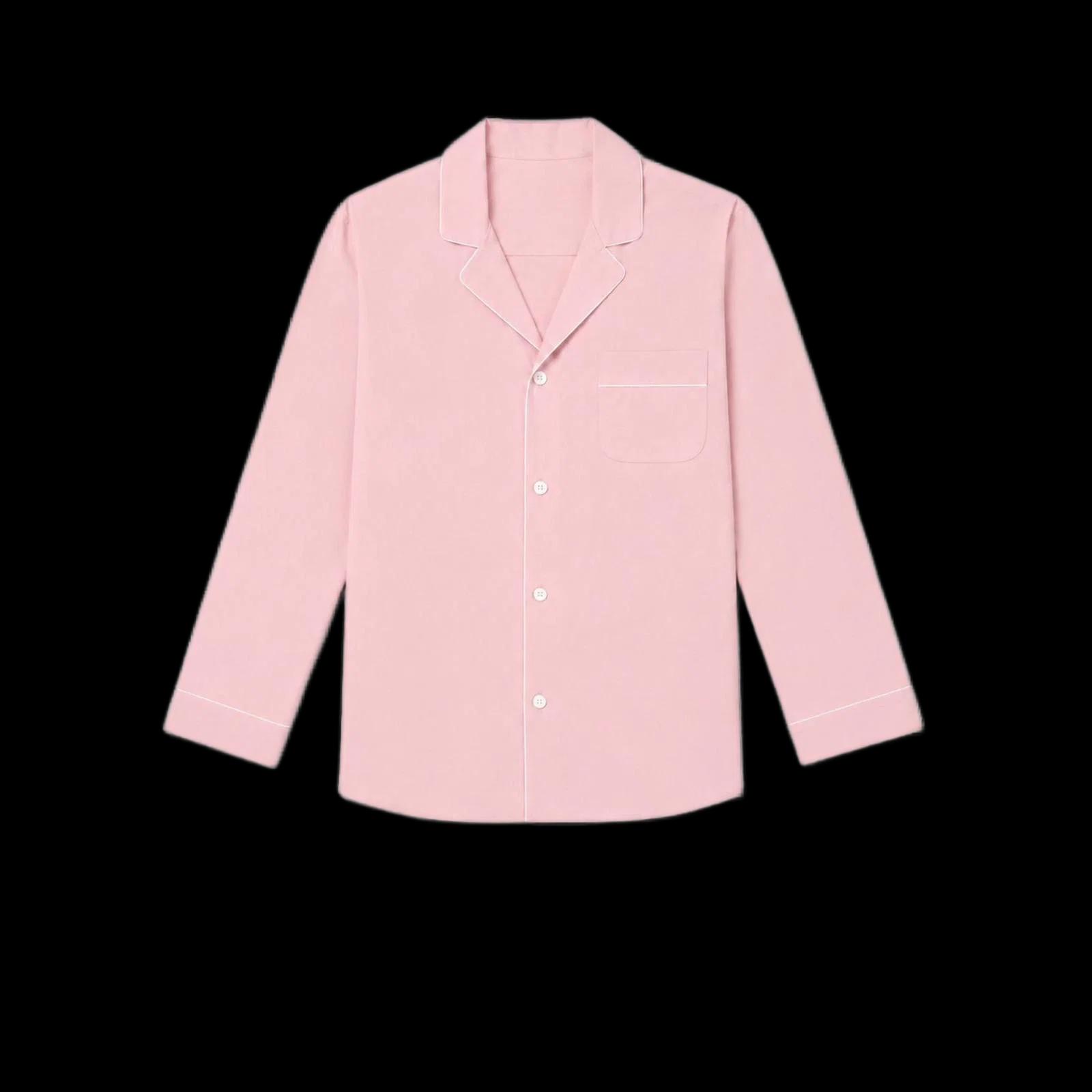
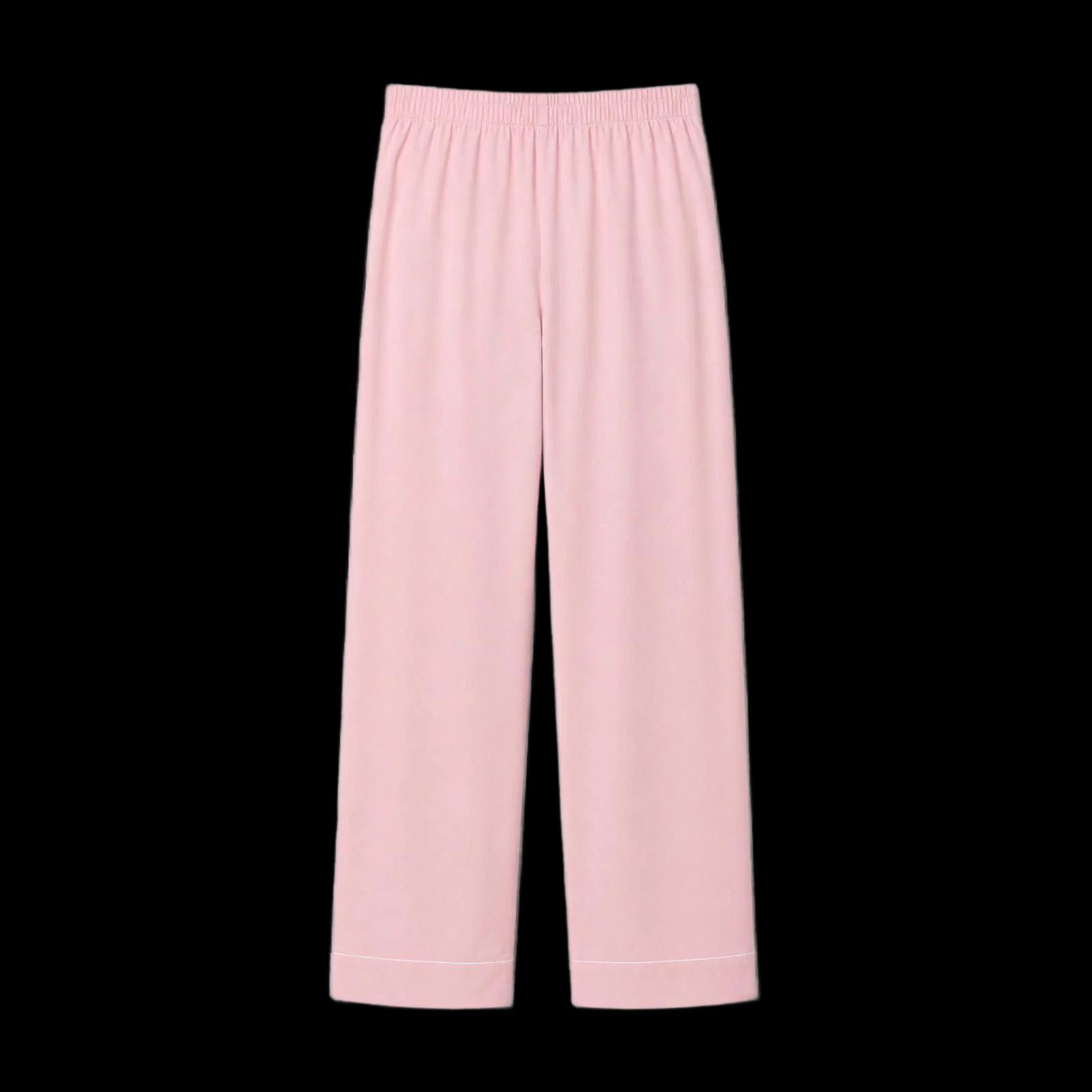
Your logo on the chest, a woven label, a back print, a colour from your brand book: Gabi designs the changes with you in the Studio and prices the finished piece before you order it. Your logo file goes on as you supply it.
Close-upFabric and finish
Replaced if faultyMade to order, so no change-of-mind returns. Anything that arrives damaged or defective, we make right.
Try one firstOne unit in Premium, made like the run, through the same checkout.
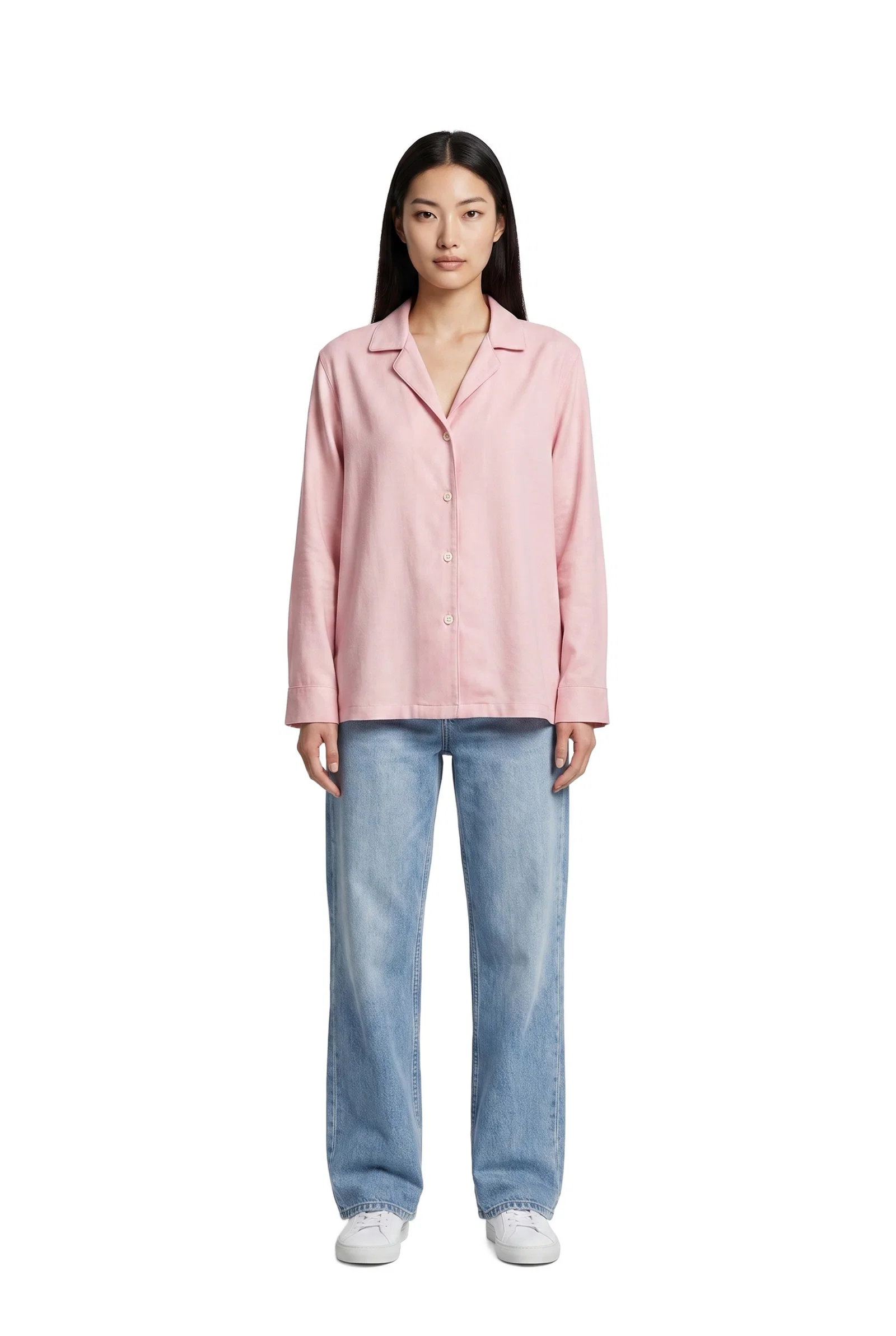
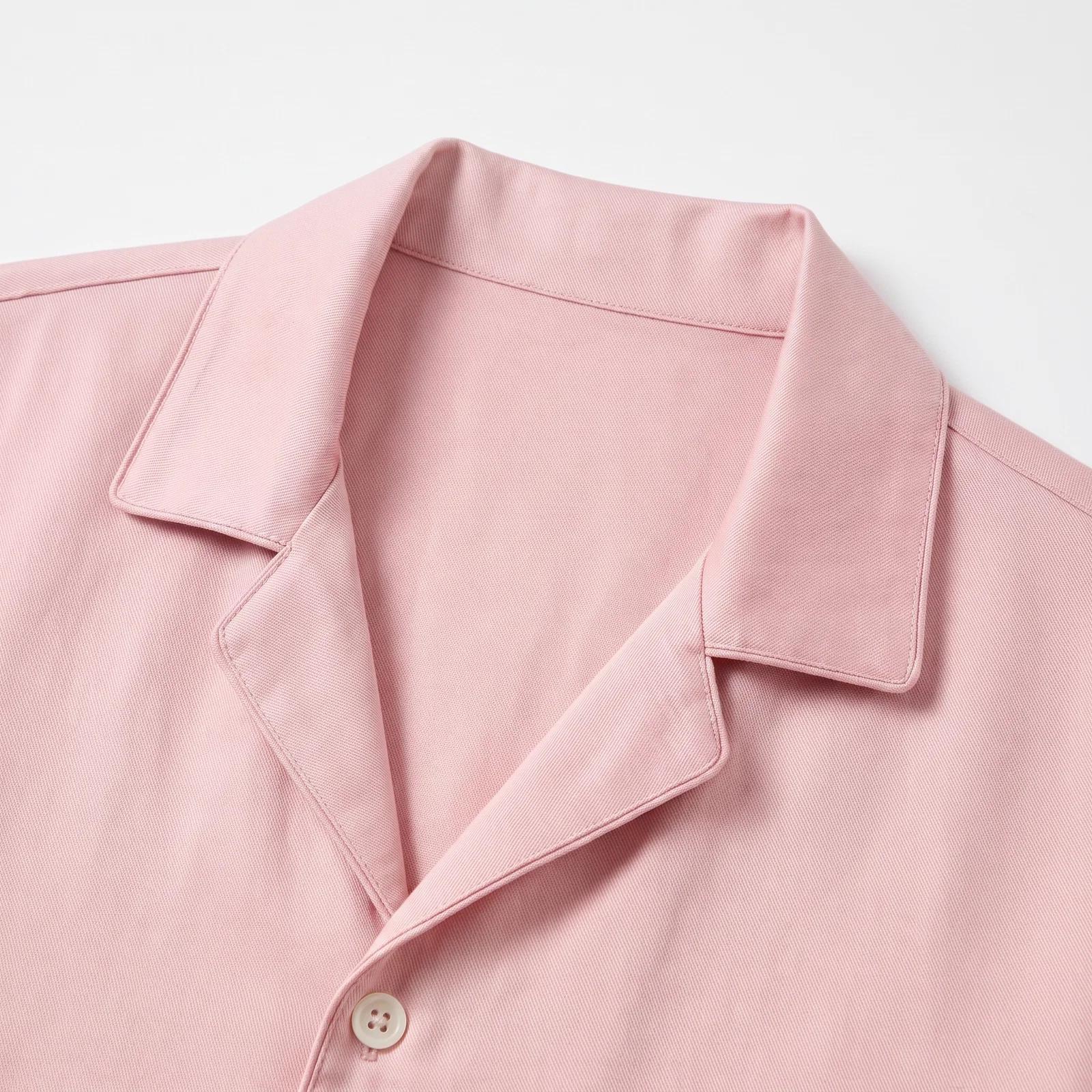
The open camp collar forms a flat, notched neckline that sits wide across the collarbone, while the straight body drops to a regular length with a level hem. Long set-in sleeves end in single-button barrel cuffs, and five front buttons close the placket. The regular cut hangs straight from the shoulders without tapering at the waist.
Specs
GradePremium, 100% Cotton Poplin
Main Fabric100% Cotton, 120gsm
interfacing100% Recycled Polyester
FitRegular
SilhouetteRegular fit button-up shirt
LengthRegular
NecklineCamp collar (revere collar) with self-fabric facing
SleeveSet-in sleeve
HemStraight hem
Closure5 x 18L 4-hole buttons on center front, 1 x 18L on each cuff
CareMachine wash at 30°C on a gentle cycle, Do not bleach, Tumble dry on low heat
Minimum order50 units
Size guide
cm
XXS
XS
S
M
L
XL
XXL
Bust
44.5
47
49.5
52
54.5
57
59.5
Length
57.5
59
60.5
62
63.5
65
66.5
The garment measured flat: compare it with one you own.
Coco Chanel started wearing her lovers clothes to bed in the 1920s and called it relaxed dressing.
The pajama entered fashion from sleepwear. By the 1970s, Yves Saint Laurent had put a woman in a tuxedo-cut silk pajama suit and sent her to dinner. The pajama set is the only garment in the encyclopedia that travels from the bedroom to the street to the red carpet without changing its construction. The silk pajama shirt tucked into wide-leg trousers at a Milan dinner is made in exactly the same factory, on exactly the same machines, as the cotton poplin pajama set someone sleeps in on a Tuesday night in London. The only thing that changes is the fabric.
A woven pajama set costs $44-251 landed depending on fabric. Cotton poplin plain set: ~$46 → $182 retail. GOTS printed poplin with piping: ~$80 → $280-$320. GOTS linen with contrast collar: ~$106 → $369. Polyester satin affordable: ~$44 → $175-$218. Silk charmeuse 19mm luxury: ~$251 → $754-$1,005. The fabric is the primary cost driver at premium and luxury tier.
It depends on the season and positioning. Cotton poplin (GOTS): the commercial standard, breathable, prints beautifully, year-round, accessible. Linen: summer premium, gets softer with washing, strong sustainability story. Brushed cotton/flannel: autumn-winter, the softest sleep fabric at affordable-premium. Polyester satin: fashion sleepwear, bold colour, affordable, high social media performance. Silk charmeuse (16-19mm): true luxury, unmatched hand and drape, significant price premium.
Momme (mm) is the weight measure for silk -- equivalent to GSM for other fabrics but measured differently. 12-14mm is entry luxury (slightly sheer, summer). 16-19mm is the premium commercial standard -- the weight specified by Olivia von Halle, Sleeper, and Desmond and Dempsey. 20-22mm is heavy luxury with structure. Always specify Momme weight on the silk tech pack -- "silk" without a Momme specification is not a complete brief.
Piping is a narrow cord covered in bias-cut contrast fabric, inserted into seams at collar, cuffs, and breast pocket. It is the defining quality signal of a premium pajama set -- immediately legible to the consumer as a crafted rather than commodity garment. It adds $3.50-5.50 CMT per set and lifts retail positioning by $60-120. For any pajama set above $150 retail target, piping at four placements is the highest-return construction detail available.
Yes -- the woven pajama set uses the same factory infrastructure as the poplin shirt (#012), linen shirt (#014), and flannel shirt (#015). The pajama-specific operations are: waistband channel construction, piping insertion, and fabric handling for satin or silk. For satin and silk, confirm the factory has specific experience with these fabrics before brief submission -- slippery fabrics require different presser feet, tension settings, and cutting technique.
Silk charmeuse requires: Teflon or roller presser foot, reduced upper thread tension, tissue paper under seam line during sewing (tear away after), no water contact on face during production, acid dye only (reactive dye damages silk fibre), dry-clean or hand-wash cold care label. Confirm the factory has silk production experience. A standard poplin factory without silk experience will produce puckering and water spotting -- both are irreversible on silk fabric.
Brushed cotton (also called winceyette or flannelette) is a cotton fabric where the surface has been passed through a brushing machine -- rollers with fine wire teeth that raise a soft nap on the fabric surface. This nap traps air and provides warmth significantly above the fabric weight. It is the defining fabric of the autumn-winter pajama market. The brushing step is a specialist finishing process -- confirm the factory has a brushing machine before brief. Care label: 30C delicate wash, do not tumble dry.
Jersey pajama sets (modal, cotton jersey) are derivable from the T-shirt (#001) and sweatpants (#004) foundation documents -- same factory, same fabric system, same CMT structure. They do not require a separate encyclopedia entry. If a creator wants to make jersey pajamas, the brief routes to the jersey factory with a coordinate dye lot requirement. The woven pajama entry covers the production logic that is genuinely distinct: brushed finishes, silk handling, piping, and woven construction.
GOTS x1.23 for organic cotton poplin, flannel, and brushed cotton. OEKO-TEX STANDARD 100 as baseline for all fabrics -- pajamas are worn against skin for extended periods. For linen: OEKO-TEX at minimum, EU Ecolabel if targeting European retail. For silk: OEKO-TEX and confirm acid-dye specification. For polyester satin: GRS x1.15-1.20 if using recycled polyester. OEKO-TEX on buttons and trims -- all components against skin.
China for all fabric routes at accessible MOQ. India for GOTS cotton poplin and block print -- strong natural-fabric and print infrastructure. Portugal for Made in Europe GOTS linen and cotton. Turkey for EU-delivery cotton poplin. Suzhou/Hangzhou (China) for silk specialist production -- this is the global silk manufacturing centre. Do not send silk to a non-specialist factory regardless of geography.
Specify pattern matching requirement explicitly on the tech pack. Apply x1.15 fabric consumption multiplier for all printed fabrics with a repeat larger than 5cm. Confirm cutting layout plan with factory before cutting begins -- the factory must lay up fabric to align pattern at side seams and centre back before cutting any panels. Pattern matching failure is the most expensive quality error in this entry: the entire fabric lot may be unusable.
HS 6207 for mens pajamas and nightwear. HS 6208 for womens pajamas and nightwear. Both cover woven fabric constructions. Jersey pajamas are classified in the same codes. The full set is typically shipped under the single HS code of the dominant piece (usually the trouser, as the higher-value item). Confirm with your customs broker -- some markets require separate classification of the shirt and trouser when sold as a set.

 Model
 Close-upFabric and finish