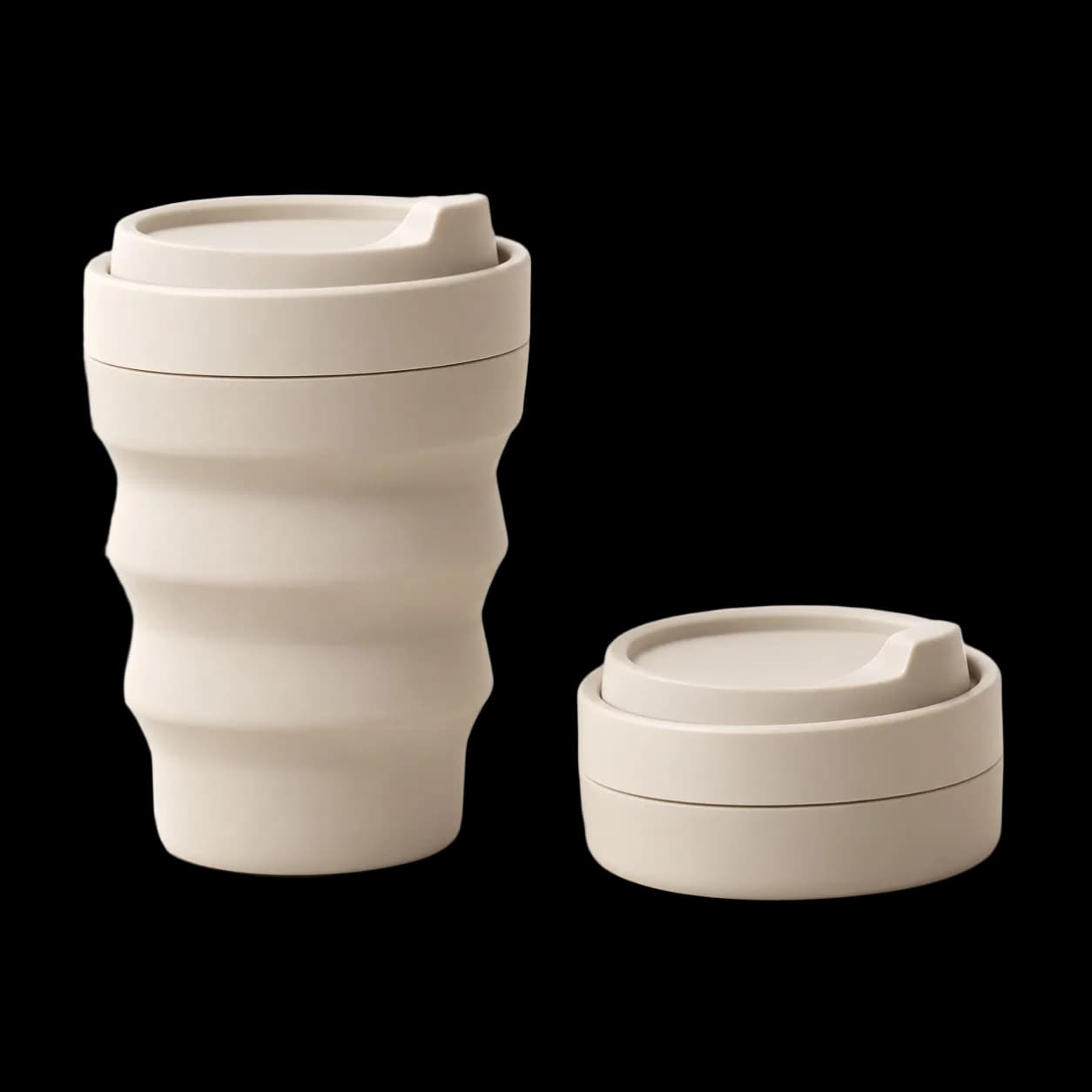
Collapsible Travel Cup

Drinkware

Collapsible Travel Cup, flat front
Flat front

This style is priced with your design. Start it with Gabi and you get the price before you order.

Replaced if faultyMade to order, so no change-of-mind returns. Anything that arrives damaged or defective, we make right.

The body is a single molded cylinder that narrows into a series of stacked accordion rings, allowing the cup to compress into a shallow disc. A rigid collar sits at the top, holding a press-fit lid with a pivoting sip cover. The flat base keeps the cup upright when extended.

Specs

Main Fabric100% Silicone, 1000gsm
Lid and Collar100% Polypropylene
SilhouetteCylindrical collapsible
NecklineThreaded or friction-fit rigid collar
HemFlat base
ClosurePress-fit or threaded lid with pivoting sip hole cover
Minimum order50 units
Encyclopedia

The vacuum flask was invented in 1892 by physicist James Dewar for keeping laboratory gases at stable temperatures, not for coffee.

Commercialized as the Thermos two years later, the same double-wall vacuum principle sat mostly in workmen's lunchboxes for a century before a 2010s social-media wave turned the insulated tumbler into one of the most-recognized consumer objects of the decade, powered by the same vacuum flask design a certain outdoor-gear brand had been quietly making since 1913.

Read the story
Encyclopedia

The story of the Collapsible Travel Cup

The vacuum flask was invented in 1892 by physicist James Dewar for keeping laboratory gases at stable temperatures, not for coffee. Commercialized as the Thermos two years later, the same double-wall vacuum principle sat mostly in workmen's lunchboxes for a century before a 2010s social-media wave turned the insulated tumbler into one of the most-recognized consumer objects of the decade, powered by the same vacuum flask design a certain outdoor-gear brand had been quietly making since 1913.

1892Vacuum flask inventedJames Dewar invented the vacuum flask for laboratory use; it was commercialized as the Thermos two years later
True vacuum, not air gapVacuum insulation mechanismAir is pumped out between the steel walls, which is why vacuum insulation outperforms simple double-wall construction
2010s social mediaModern tumbler boom driverA 1913-era vacuum flask design became a viral consumer object a century after it was first made for workers

A Lab Instrument Becomes a Lunchbox Staple

The vacuum flask's 1892 scientific origin and its long, slow path to becoming a mainstream consumer object.

Vacuum insulation uses double-wall stainless steel with the air pumped out between the layers, a true vacuum rather than a simple air gap, which is why it dramatically outperforms basic double-wall plastic or glass.

Collapsible travel cups use a silicone body that folds flat for storage, trading insulation performance for pack size, aimed at travel and hiking use where space matters more than heat retention.

A protein shaker uses a wire or mesh agitator ball inside a single-wall bottle, relying on shaking motion rather than insulation — mixing, not temperature retention, is the design goal.

Questions

A double-wall vacuum-insulated tumbler (China, 300–500 unit run) lands around $4–8; a collapsible silicone travel cup runs $2–4; a protein shaker runs $1.50–3, since it doesn't require vacuum insulation.

SHOPPING BAG

(0 items)